
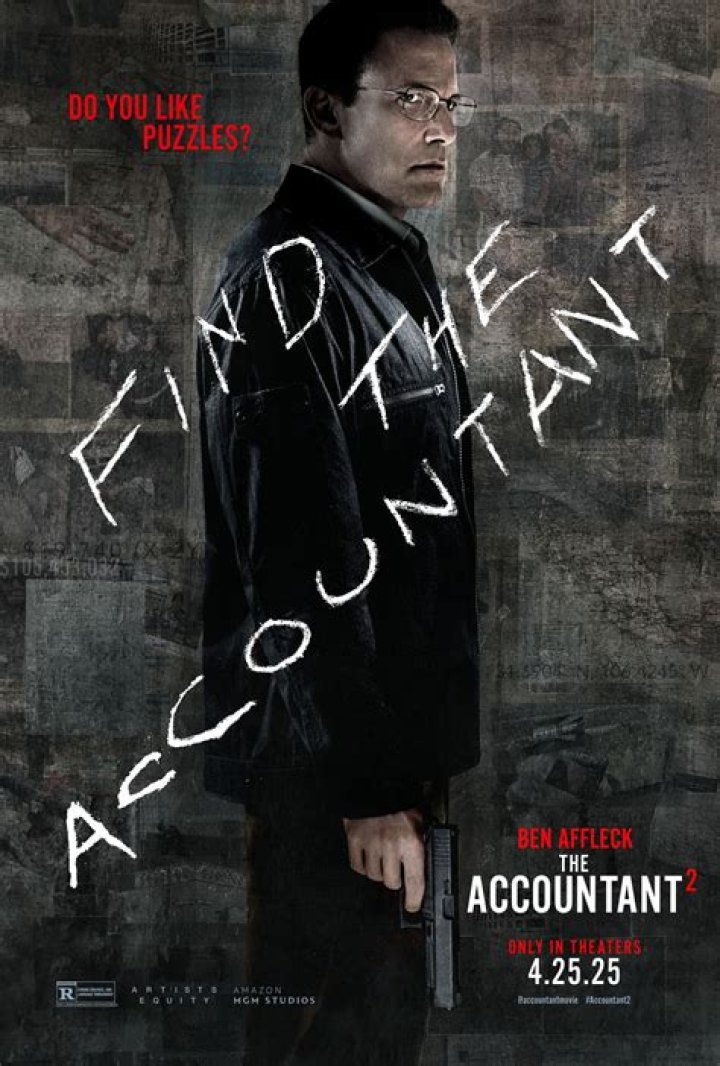
Starring Ben Affleck, the 2016 sleeper action hit The Accountant ended on a high note with a series of unexpected twists and turns.

Summary
- "The Accountant" was a surprise hit due to Ben Affleck's strong performance and a twist ending that elevated the movie above typical action fare.
- Despite receiving mixed reviews, the film exceeded expectations at the box office, grossing over $150 million.
- The use of famous paintings in the film symbolized larger themes, such as the unpredictable world Christian tries to fix and his severed relationship with his mother. Additionally, the identity of the mysterious assassin turned out to be Christian's estranged brother, adding another twist to the story.
2016's The Accountant was an unexpected hit due in large part to a strong performance from Ben Affleck and a surprise twist ending that elevated the movie above the usual action fare. Directed by Gavin O'Connor (Warrior), The Accountant concerns Christian Wolff (Affleck), a brilliant number cruncher on the autism spectrum who provides his services to high-profile criminal clients. Weaving a complicated web of corruption and intrigue, The Accountant manages to deftly blend its action-oriented premise with a genuinely effective mystery storyline. The film also represented a return to form for Affleck, who became something of an action star in the 2010s.
As is the case with many high-concept action flicks, The Accountant was given generally middling reviews from critics who picked apart its plot holes and were unsatisfied with its convoluted story (via Rotten Tomatoes). However, the movie was a sleeper hit, and it far outperformed expectations when it grossed over $150 million (via Box Office Mojo). Though the film came out back in 2016, The Accountant 2 was confirmed in 2023 and the underrated thriller is set to become a franchise with many key collaborators returning. While it is unclear how a sequel will perform after so long, the ending of The Accountant certainly left many wanting even more.

Best Action Movies Of The Decade
As one of the highest grossing movie genres in Hollywood, it seems like fans can’t get enough of their favorite action superstars.The Significance Of The Paintings

While The Accountant was a smarter film than the usual run-of-the-mill action schlock, it still wasn't necessarily jam-packed with symbolism. However, the movie did use three very famous paintings to speak to much larger themes presented in the subtext of the story. Through his underhanded dealings, Christian received notable works of art as payment from his wealthy criminal clients, the first of which was Jackson Pollock's Free Form. Pollock's work is known for its splattered and seemingly disorganized style, and that represents the unpredictable world that Christian is constantly trying to fix through his rigid organization.
The second of the three paintings in The Accountant is Pierre-Auguste Renoir's Woman with a Parasol and Small Child on a Sunlit Hillside which is a classic piece of Impressionist art. With its idyllic colors and softness, the painting symbolizes Christian's severed relationship with his mother, the thing that ultimately set him on the path to becoming "The Accountant". Finally, and rather humorously, the last painting is A Friend in Need by Cassius Marcellus Coolidge, which is best known as "Dogs Playing Poker". Though the work is actually quite clever, it has long been a symbol of low-brow art, which conflicts with Christian's inability to understand the humor of others.
Ray's Connection To The Mysterious Voice

Throughout the film, Ray King (J.K. Simmons) is something of a minor antagonist as he collaborates with fellow Treasury Department agent Marybeth (Cynthia Addai-Robinson) to discover the identity of "The Accountant". It isn't clear why he has such a grudge until it is revealed that Ray had actually had a run-in with Christian following the latter's attack on the mob hideout. The film also revealed that Ray had been receiving tips from the very same mysterious voice as Christian, which linked the two men. Like Christian, the voice helped Ray become better at his job, and he was able to rise from a lackluster agent to the director of FinCEN.
Lamar Was Behind The Whole Thing

Though The Accountant is one of Ben Affleck's best movies, it was also bolstered by strong performances from its supporting cast. John Lithgow appears in the film as Lamar Blackburn, the CEO of Living Robotics who hires Christian to help him solve the financial mystery of $60 million missing from his company's books. Though the job was originally pitched to Christian as a "legitimate" opportunity, the savvy accountant soon ascertained that something bigger was afoot. With the company's CFO turning up dead of an apparent intentional overdose, and the eventual attack on Christian's partner Dana (Anna Kendrick), Christian is forced to put his other skills to good use.
In the film's final act, it is revealed that Lamar had actually been behind the scheme the entire time, a conclusion Christian reached by remembering the dirty dealings of an electronics company from his past. Lamar stole from the company only to then use the very same money to invest in the company which caused its stock value to inflate. Lamar was willing to go to any lengths to protect his secret because he justified it as the right thing to do. He claimed he was helping people, an excuse that Christian himself used to support his own actions.
The Assassin’s Identity

Occasionally popping up in The Accountant to wreak havoc, a mysterious assassin was holding people hostage and even killing at the behest of his employer. While the employer was eventually revealed to be Lamar, the identity of the assassin was another big shock that rocked the movie's third act. Turns out, the assassin was actually Christian's estranged brother Braxton (Jon Bernthal) who had the very same intensive training. Jon Bernthal's movie and TV roles often see him playing tough guys, and he fit right in as the battle-hardened killer, but his character had a bit more nuance.
Realizing that his enemy was really his brother, Braxton turned on his henchmen in order to protect Christian. As seen in flashbacks, Braxton was supportive of his brother when they were younger, and he learned alongside Christian to refuse to be a victim. Braxton may have seemed like a villain at first, but he wasn't all that different from his brother who also used violent tactics to turn the tables on those who challenged him.
Why Christian Gave Dana The Paintings

Christian and Dana collaborated during their financial investigation into the missing funds at Living Robotics, and they became even closer once their lives were threatened by the assassin. Christian clearly had feelings for Dana, but was unsure how to approach the situation due to his ASD. As evidenced by their awkward interaction in the fancy hotel, Christian wanted to get to know her but went about it in strange ways. In the end, Christian is back on the lam and in need of a new identity, but he leaves a parting gift for Dana that is a touching tribute to their friendship and reveals something about his character.
Earlier, Dana had remarked on his owning a Jackson Pollock painting, and she quipped that her father's idea of high art was "Dogs Playing Poker". Therefore, as a humorous but thoughtful gesture, Christian gifted Dana his original copy of A Friend in Need, but secretly stashed the Pollock behind it. Symbolically speaking, the choice was quite telling, as the Pollock behind the Coolidge was representative of the chaos that exists behind the order. It also was Christian's way of showing affection since Dana commented on liking Pollock earlier.
The Justine Twist Explained
Even after a handful of shocking twists, The Accountant had one last big reveal for the final scene which completely re-contextualized the film. Earlier, a flashback was shown which introduced Christian's ASD and explained his time at Harbor Neuroscience as a child. In the flashback scenes, Christian meets and befriends a girl at the facility who is non-verbal. Together they construct a puzzle of famed boxer Mohammed Ali, while Christian's parents debate sending him to the facility for treatment. Though that moment seemed just to be backstory it actually explained a loose end that was a thread throughout the movie.
Even the best action movies rely on gimmicks and story conveniences to get to the exciting bits, and The Accountant featured an omnipresent mysterious voice that advised Christian and Ray. However, that voice is revealed to be more than just a plot convenience when the last scene of the movie returns to Harbor Neuroscience in the modern day with another curious family. The young child meets a woman who is nonverbal, and the doctor explains that she is his daughter and that she communicates via a computer. The Mohammed Ali puzzle is shown once again, which implies that the non-verbal woman, Justine, is actually the mysterious voice.

10 Action Movie Plot Twists That Everyone Saw Coming
From the plot twists in Mission: Impossible to Indiana Jones, which action movie "surprises" did fans always see coming?The Real Meaning Of The Accountant’s Ending

Though The Accountant did get flack for its portrayal of autism spectrum disorder, it was still integral to the themes of the movie and wasn't an afterthought. Christian is intended to be a hero of sorts because his ASD doesn't hinder him but actually makes him stronger. The Accountant ended on a note that confirmed that theme, as Justine is actually the mastermind who has helped Christian and Ray, and though she is non-verbal she has learned to compensate. The point isn't to glorify ASD, but instead to show that a hero is a hero because of what they can overcome.